
Residential & Commercial Epoxy Specialists
Driveway Floor Coating in Wollongong for Existing Concrete Driveways
- Illawarra-Wide Coverage
- Fast, Free Quotes
Get a Free Quote
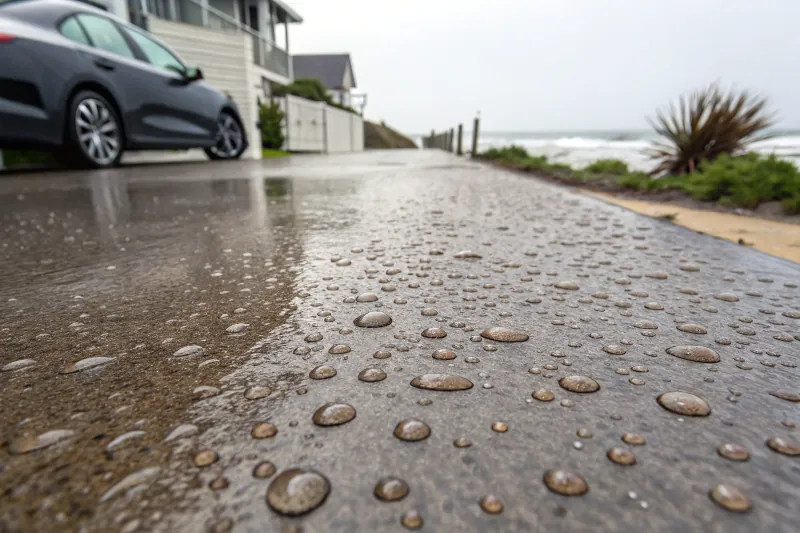
Our driveway floor coating service in Wollongong is for existing concrete driveways. The coating is applied over concrete that is already in place.
Many people start looking into a driveway coating when their concrete looks stained, weathered or dull. Others are unhappy with their kerb appeal and how the front of the home looks from the street.
This page explains how a coating system is chosen for a driveway that sits outdoors in the sun and rain. It covers why preparation matters and how we check whether your concrete is suited to coating. It also covers slip-resistance options, why dry weather affects scheduling, and where the coating typically stops.
To talk about your driveway, call Local Epoxy Flooring Wollongong on 0242026324 to request an assessment or quote.
What Driveway Floor Coating Covers and What It Doesn't
Driveway floor coating is a resin-based system applied over existing exterior concrete. Depending on the system, the resin may be epoxy, polyaspartic/polyurea or a hybrid of these.
A driveway coating job typically includes:
- An assessment of the existing concrete
- Mechanical preparation of the surface
- Filling cracks and surface defects
- A primer or base coat
- Optional decorative flake and slip-resistant aggregate
- A UV-stable topcoat
Some driveway work falls outside this service. Driveway floor coating does not include:
- Laying new concrete or replacing a driveway
- Structural repairs to the slab
- Changing driveway levels or drainage
- Cement overlays or resurfacing
- Simple penetrating or acrylic sealers
If your driveway needs one of these, it's a different type of job. If your concrete is in place and you want it coated, this is the service to ask us about.
Why the Topcoat Matters on a Sun-Exposed Driveway
Can you put epoxy on a driveway? Epoxy can form part of a driveway coating system, but it shouldn't be left exposed on its own. Technical literature states that epoxy coatings generally lack good weathering resistance in sunlight. Under UV exposure, epoxy can chalk, and its gloss and colour can change.
For this reason, epoxy used outdoors is typically top-coated with a more weatherable coating, such as an aliphatic polyurethane.
Aliphatic polyaspartic coatings are another option. Manufacturers describe these coatings as UV-stable and non-yellowing.
Practical system options for a driveway include:
- An epoxy base coat with an aliphatic topcoat
- A polyaspartic system
- Either of these with decorative flake broadcast into the coating
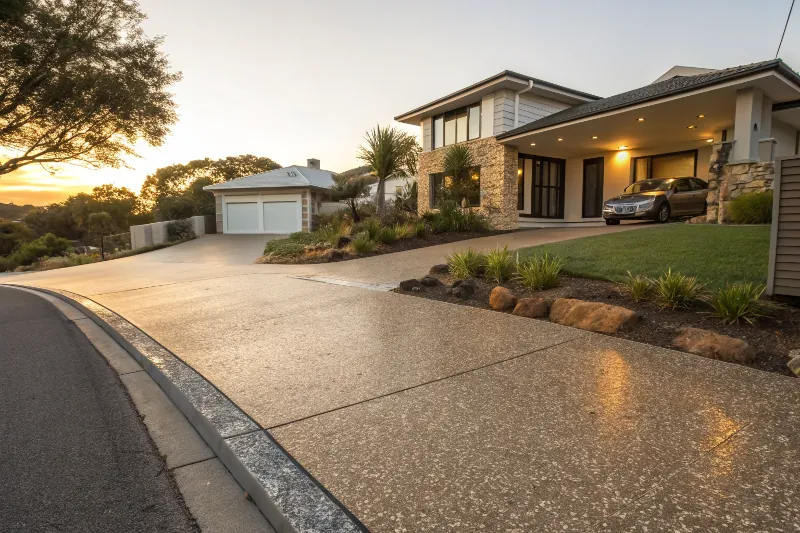
You may read conflicting claims online about epoxy on driveways. The key point is that the system and topcoat chosen play a large part in how a coating holds up outdoors. Suitability also depends on the condition of your concrete and how well it is prepared, which we cover next.
Surface Preparation and Whether Your Concrete Is Suited to Coating
A driveway coating relies on a good bond with the concrete underneath. That bond starts with preparation.
Manufacturer data sheets call for mechanical preparation, such as grinding, to reach a defined concrete surface profile (CSP). The profile required depends on the product being used. This is why a coating isn't simply rolled onto the concrete as it is.
Before application, the conditions are checked as well. Data sheets call for measuring:
- Moisture in the concrete
- Air humidity
- Temperature
- Dew point
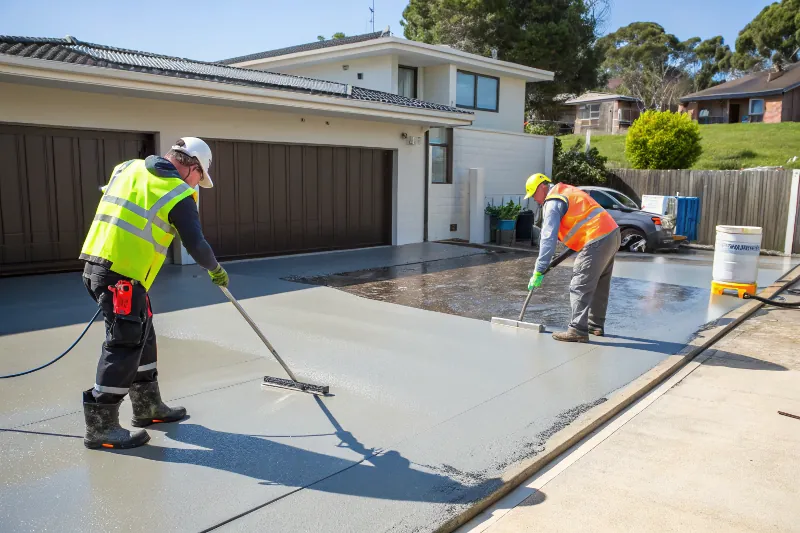
Cracks and surface defects are filled before coating begins.
Some driveways need extra work before a coating is feasible. This may include:
- Oil stains or other contamination
- Old sealers or coatings that are still on the surface
- Moisture coming through the slab
These are the kinds of things an assessment looks at when deciding whether your concrete is suited to coating.
Preparation creates dust and slurry, which should be kept out of stormwater drains. Wollongong City Council notes that stormwater can carry pollution into local creeks, Lake Illawarra and the ocean. The NSW EPA states that it is illegal to let material enter waterways.
Slip-Resistance Options for Driveways That Get Wet
A coated driveway can be made more slip resistant. This is done by adding slip-resistant aggregate within the coating system.
The type and amount of aggregate affects how the surface feels and looks. A more textured finish will feel different underfoot from a smoother one.
In Australia, slip resistance is classified under AS 4586-2013. This standard uses a wet pendulum test, with ratings from P0 to P5. A separate handbook, SA HB 198, gives guidance on choosing a suitable surface. It is a guide only.
Slip resistance is one of the system choices to talk through with us when you request a quote. We can go over the aggregate options and how each one changes the finish of your driveway.
Installation Depends on Dry Weather and a Dry Slab
A driveway coating needs the right conditions to go down well. Manufacturer data sheets restrict application around:
- Rain
- High humidity
- Damp surfaces
- Temperatures close to the dew point
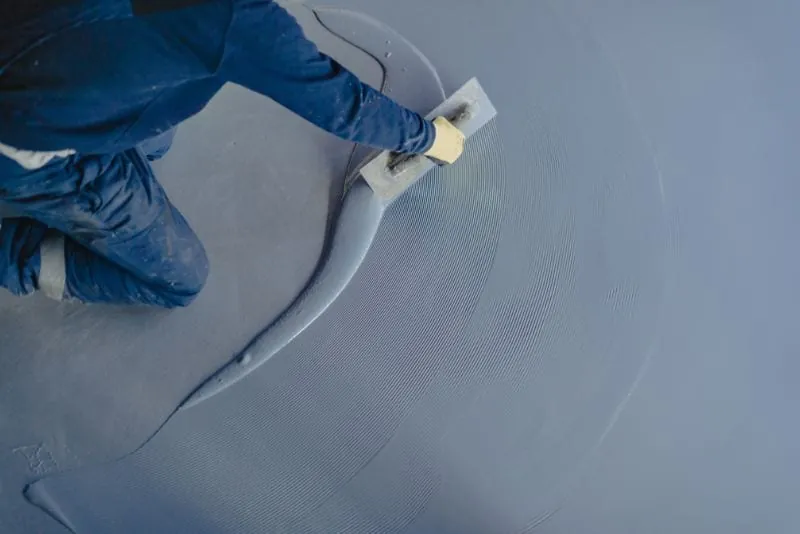
The exact limits vary by product.
Applying a coating to a damp surface can cause problems. Depending on the product, these can include whitening, blushing or delamination, where the coating lifts away from the concrete.
Rain is a regular part of life in Wollongong. Bureau of Meteorology records for the Bellambi AWS and Wollongong University weather stations show the area averages around 92 to 101 rain days per year.
Because of this, installation dates are weather dependent. If rain, humidity or a damp slab make conditions unsuitable, your job may need to be rescheduled. We'll keep you informed if a date needs to move.
Where the Coating Typically Stops: Council Guidance on Footpath Crossovers
The crossover is the section of driveway between your property boundary and the road. It sits in the road reserve, which is public land rather than part of your property.
Wollongong City Council guidance states that crossovers in the road reserve must be slip resistant to AS/NZS 4586:2013. The guidance limits the finish to plain concrete with a broom or cove finish, or rough exposed aggregate. It states that paint, sealers, grit and other coatings must not be used.
Because of this, a driveway coating typically stops at the property boundary.
The NSW Planning Portal also states that works on a vehicle crossing need approval from the roads authority.
Keep in mind that Council's guidance is general advice written for building and replacing driveways. If you have questions about your crossover, check with Council directly. You can read the Wollongong City Council driveway guidance on its website.
Frequently Asked Questions
What affects the cost of coating a driveway?
Several things affect the cost of a driveway coating, including:
- The size and shape of the driveway
- The condition of the concrete and any contamination, such as oil
- Whether previous coatings or sealers need removal
- How much preparation is needed
- Whether moisture in the slab needs treatment
- The coating system chosen, including any flake or slip-resistant aggregate
- Weather and scheduling
- Access to the driveway and its slope
The crossover in the road reserve is not part of the coated area. An assessment gives us what we need to prepare a quote for your driveway.
How long before I can drive on a newly coated driveway?
It depends on the product used and the conditions at the time. Curing times vary between coating systems, and weather also plays a part. We'll confirm the timing for the system chosen for your driveway.
Can a coating go over cracked or previously sealed concrete?
Often, yes, depending on the condition of the concrete. Cracks are typically filled before coating. Previous sealers or coatings may need to be removed first.
An assessment tells us whether coating is feasible for your driveway. Structural problems with the slab fall outside the scope of a coating job.
How is a driveway coating different from a concrete sealer?
They are different types of products. A penetrating or acrylic sealer is a single product applied to the concrete. A driveway coating is a resin system built up in layers, such as a primer or base coat and a topcoat, with optional flake or aggregate.
How do I clean and maintain a coated driveway?
General care includes sweeping away dirt and debris and cleaning up spills. The right cleaning products and methods depend on the coating system used. Follow the manufacturer's care guidance for your system, and ask us if you're unsure which system is on your driveway.